Exam Preparation
How to Solve Difficult Maths Questions: A Step-by-Step Guide for Students
BAMIDELE, KAYODE · 22 September 2026
Have you ever looked at a maths question and thought:
“I don't even know where to start.”
You read the question once. Then you read it again. You look at the numbers, the symbols and the instructions, but nothing seems to make sense.
Getting stuck on a maths question does not mean you are bad at mathematics.
Sometimes, the problem is not that you don't know the mathematics. You may simply need to understand what the question is asking, identify the information you already have, and choose the right method.
The good news is that solving difficult maths questions is a skill that can be developed.
In this guide, we'll look at practical steps students can use when they get stuck — and how teachers, parents and learning tools such as an AI Maths Tutor can support that process.
1. Don't Panic When a Question Looks Difficult
The first step is simple:
Stay calm.
When students see a complicated question, it is easy to immediately think:
“I can't do this.”
But don't make that decision before you've actually examined the question.
Instead, ask:
“What part of this question don't I understand?”
That question is much more useful.
You might discover that you understand the topic but don't know which formula to use.
Or perhaps you understand the first part but don't know what to do next.
Or maybe the question simply contains too much information and you need to separate the important information from the unnecessary details.
Once you identify the actual problem, you have something you can work on.
2. Read the Question Carefully
One of the most common mistakes students make is starting calculations too quickly.
Before reaching for a calculator or writing down numbers, read the entire question.
Pay attention to words such as:
Find Calculate Solve Simplify Expand Factorise Estimate Compare Express Show that
These words tell you what the question expects you to do.
Example
Consider this question:
A shop gives a 20% discount on a school bag that costs ₦15,000. Calculate the discount.
If you rush, you might start working with the numbers without thinking about what is being asked.
But if you read carefully, you can identify:
Original price = ₦15,000
Discount = 20%
Required = discount amount
Now you know what you are looking for.
3. Ask: “What Do I Know?”
When you are stuck, don't focus only on what you don't know.
Start with what you do know.
Write down the information given in the question.
For example:
A rectangle has a length of 12 cm and a width of 5 cm. Find its area.
You know:
Length = 12 cm
Width = 5 cm
You are looking for:
Area
Now the question becomes much simpler.
You know the formula:
Area = length × width
Therefore:
Area = 12 × 5
Area = 60 cm²
The difficult part wasn't necessarily the multiplication.
The important step was identifying the information you already had.
4. Ask: “What Am I Trying to Find?”
This is another powerful question.
Before you begin solving, identify your target.
Are you trying to find:
x? An angle? An area? A perimeter? A percentage? A probability? A distance? A missing number? A value? Example
Solve:
4x + 8 = 24
What do you know?
4x + 8 = 24
What are you trying to find?
x
Once you identify your target, you can start thinking about how to isolate x.
5. Identify the Maths Topic
If you don't know where to start, ask yourself:
“What topic is this question testing?”
For example, is it:
Algebra? Fractions? Percentages? Geometry? Trigonometry? Probability? Statistics? Simultaneous equations? Indices? Graphs? Number bases?
Recognising the topic can help you remember the rules, formulas and methods associated with it.
For example:
2x + 6 = 14
This is an algebraic equation.
That tells you that you need to use algebraic operations to find x.
6. Choose the Right Method
Once you understand the question, think about which method can help you solve it.
Let's return to:
4x + 8 = 24
We want to find x.
First, subtract 8 from both sides:
4x = 24 − 8
4x = 16
Now divide both sides by 4:
x = 4
The answer is:
x = 4
But don't stop there.
Ask yourself:
“Why did I subtract 8?”
“Why did I divide by 4?”
Understanding these decisions is what helps you solve similar questions in the future.
7. Show Your Working
One of the best habits a maths student can develop is to show the working.
Don't try to do everything in your head.
Write down each step.
For example:
4x + 8 = 24
4x = 24 − 8
4x = 16
x = 16 ÷ 4
x = 4
Showing your working has several benefits.
It can help you:
Organise your thoughts Follow your reasoning Identify mistakes Remember methods Explain your answer See where you became stuck
It also makes it easier for a teacher to understand your thinking and help you when something goes wrong.
8. Find the Exact Point Where You Got Stuck
Sometimes a student says:
“I don't understand the question.”
But after looking at the working, the teacher discovers that the student actually understands most of it.
They are simply stuck at one particular step.
So ask yourself:
Where exactly did I become confused?
Maybe:
You don't understand the question. You don't know what information is important. You forgot a formula. You don't know which operation to use. You made a calculation error. You don't understand one of the steps.
Finding the exact point where you got stuck makes it much easier to get useful help.
9. Don't Just Look for the Final Answer
This is especially important when using technology or AI.
It can be tempting to type a question into an AI tool and immediately look for the final answer.
For example:
2x + 6 = 14
If the tool tells you:
x = 4
you now have the answer.
But do you understand why?
A better approach is to study the steps:
2x + 6 = 14
Subtract 6:
2x = 8
Divide by 2:
x = 4
Now you understand the method.
That's much more useful because you can apply the same process to another equation.
10. Use an AI Maths Tutor as a Learning Tool
AI can be useful when a student gets stuck on mathematics.
An AI Maths Tutor can provide step-by-step explanations that students can study and use as additional learning support.
But there is an important difference between using AI to learn and using AI to copy.
Don't do this:
Question → AI → Copy answer → Done
Try this instead:
Question → Attempt → Get help → Study the steps → Understand → Try again
That approach keeps the student involved in the learning process.
Neslern is an AI-powered mathematics learning platform built around step-by-step mathematics. Students can use it to explore mathematics questions, study the working behind solutions and practice by topic.
Explore Neslern at neslern.com
11. Ask Your Teacher for Help
Technology can be useful, but teachers remain an important part of mathematics learning.
If you are stuck, don't be afraid to ask your teacher.
However, try to ask a specific question.
Instead of:
“I don't understand.”
You could say:
“I understand the first two steps, but I don't understand why we divided by 4.”
That gives your teacher a much clearer idea of what you need help with.
A Tip for Teachers
When helping a student who is stuck, you don't always need to give the answer immediately.
Try asking:
“What do you know?”
“What are you trying to find?”
“What topic is this?”
“Which formula might apply?”
“What could you try first?”
These questions can help students develop their own problem-solving skills.
12. Try the Question Again
Once you've received an explanation, try solving the question again without looking at the solution.
This is important.
If you simply read a solution and think:
“Oh, that makes sense.”
you may not actually be able to reproduce the method yourself.
Close the explanation.
Take a fresh sheet of paper.
Try again.
If you can solve it independently, you are beginning to move from understanding an explanation to using the method yourself.
13. Practise a Similar Question
One question is rarely enough to master a topic.
After learning how to solve one problem, try another with different numbers.
For example, after solving:
4x + 8 = 24
try:
5x + 10 = 30
Can you solve it without looking at the previous example?
Then try something slightly more challenging.
This helps you develop the ability to apply a mathematical method to new situations.
14. Learn From Your Mistakes
Getting a maths question wrong doesn't mean you have failed.
A mistake can show you exactly what you need to improve.
Instead of simply correcting the answer, ask:
“Why did I get this wrong?”
Maybe you:
Misread the question. Used the wrong formula. Made a calculation error. Forgot a negative sign. Used the wrong mathematical operation. Skipped a step. Misunderstood a mathematical concept.
Once you understand the reason for the mistake, you can work on that specific area.
For Teachers
When marking students' work, try to look beyond the final answer.
The working can reveal how the student is thinking.
A wrong answer with useful working can sometimes tell you more about what the student understands than a correct answer with no explanation.
15. Check Your Final Answer
Even after you reach an answer, don't immediately move on.
Take a moment to check it.
Ask:
Does my answer make sense?
Did I copy the numbers correctly?
Did I use the correct formula?
Did I include the correct units?
Can I substitute my answer back into the equation?
For example:
4x + 8 = 24
If:
x = 4
check:
4(4) + 8 = 24
16 + 8 = 24
24 = 24 ✓
Your answer works.
Checking your work can help you catch avoidable mistakes before submitting your answer.
How Neslern Can Support Mathematics Learning
Neslern is an AI-powered mathematics learning platform designed to support students as they learn and practice mathematics.
Its approach focuses on step-by-step solutions, so students can examine the working behind a result rather than simply looking for an answer.
Neslern also provides practice by topic and supports learning around:
WAEC • NECO • JAMB • O-Level/IGCSE
Teaching staff review and improve answers in the question bank, adding another layer of educational input.
For students, Neslern can provide additional support when they are practising or get stuck.
For teachers, it can serve as an additional resource that students can use alongside classroom teaching.
Visit Neslern
A Simple 7-Step Method for Difficult Maths Questions
The next time you get stuck, remember:
🟢 1. READ
Read the question carefully.
🟡 2. IDENTIFY
What information do you already have?
🟢 3. FIND
What exactly are you being asked to find?
🟡 4. CHOOSE
What formula, rule or method can you use?
🟢 5. WORK
Show your steps.
🟡 6. CHECK
Does your answer make sense?
🟢 7. LEARN
Understand what you did and try another question.
For Teachers: Help Students Learn the Process
If you're a mathematics teacher, you can use these seven steps as a simple classroom routine.
When a student says:
“Sir/Ma, I don't know how to solve this.”
Instead of immediately giving the solution, ask:
1. What does the question tell you?
2. What are you being asked to find?
3. What topic is this?
4. What formula or method might apply?
5. What can you do first?
This encourages students to think about the problem instead of depending entirely on someone else to solve it.
Technology can then provide additional support when appropriate.
The goal is not to replace the teacher.
The goal is to give students more opportunities to practise, understand and try again.
Conclusion: Don't Just Ask “What's the Answer?”
The next time a maths question looks difficult, don't immediately give up.
Don't immediately guess.
And don't simply search for the final answer.
Instead:
Read the question.
Identify what you know.
Identify what you need to find.
Choose a method.
Show your working.
Check your answer.
Learn from your mistakes.
And when you need additional support, use the available resources — including your teacher and appropriate learning technology — to help you understand the problem.
Because the real goal of mathematics isn't simply to get:
x = 4 ✓
The real goal is to understand:
Why is x = 4?
Once you understand the method, you are better prepared for the next question.
Don't just get the answer. Understand the method.
Explore Neslern and start learning mathematics step by step:
www.neslern.com
Neslern — Your AI Maths Tutor.
Log in to react to this post.
Frequently asked questions
Stuck on a maths question right now?
Neslern solves it step by step, written the way a real maths teacher would explain it — free to start, no card required.
Related articles
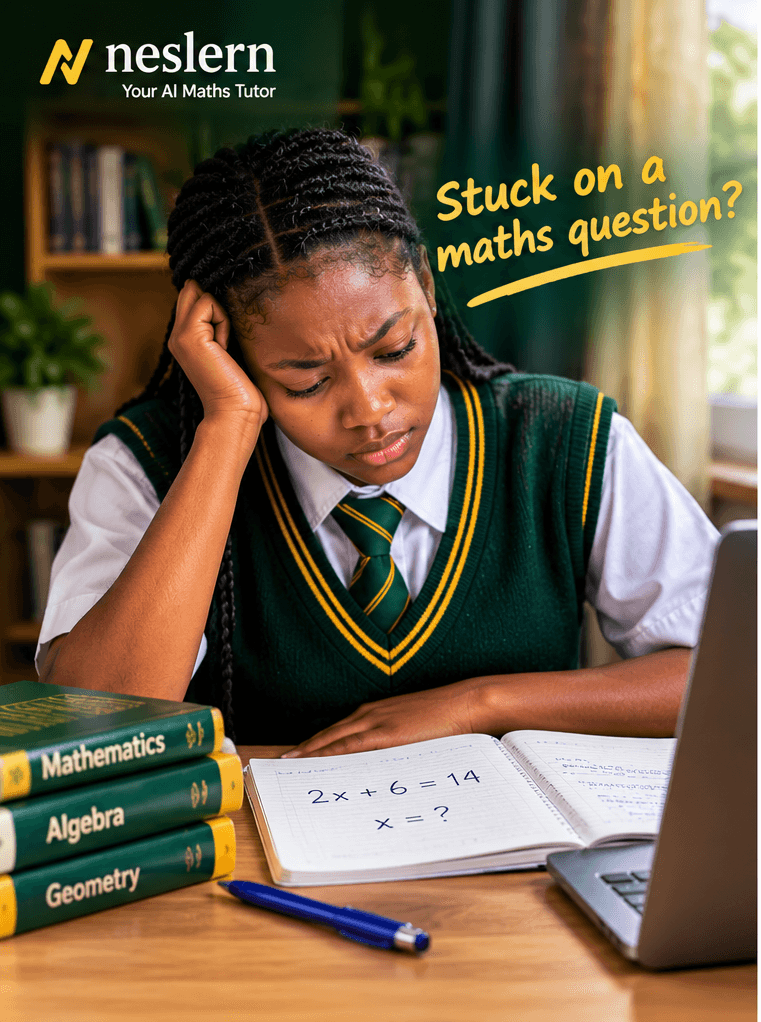
What to Do When You Get Stuck on a Maths Question