Exam Preparation
What to Do When You Get Stuck on a Maths Question
BAMIDELE, KAYODE · 15 September 2026
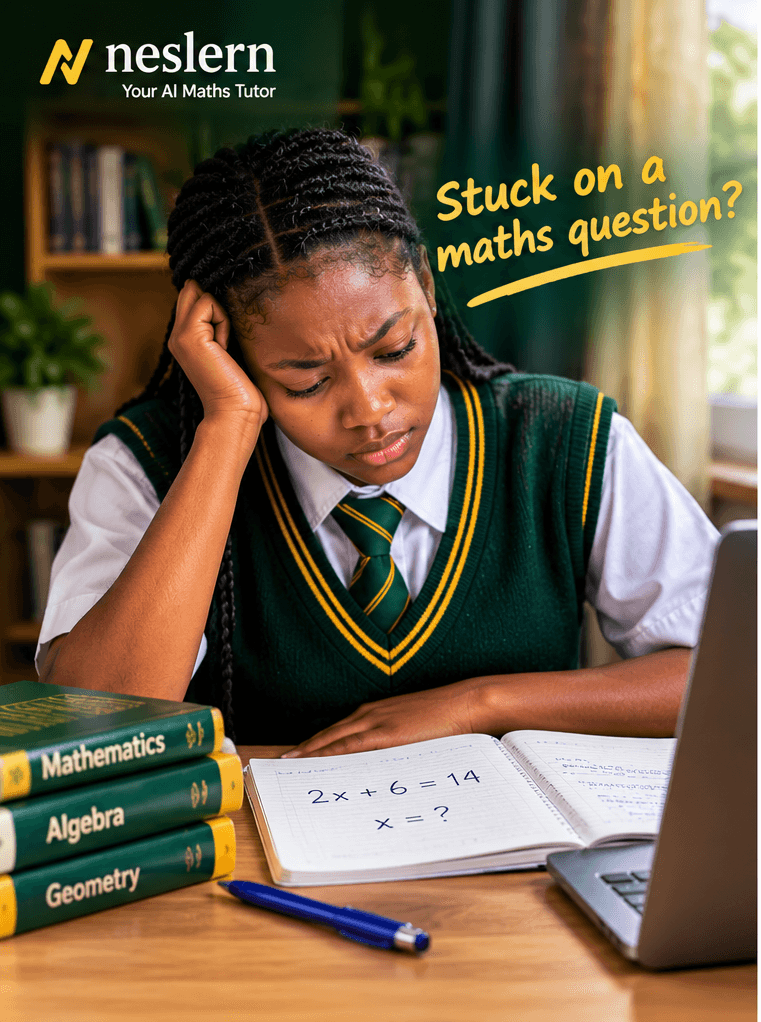
Have you ever looked at a mathematics question and thought:
"I don't even know where to start."
You are not alone.
Getting stuck on a maths question does not necessarily mean you are bad at mathematics. Sometimes, the problem is not the calculation itself. You may simply need to understand the question better, identify the information given, or choose the right method.
The important thing is what you do after getting stuck.
Instead of guessing, giving up, or immediately looking for the answer, you can follow a simple process:
Read → Identify → Choose → Work → Check → Learn
In this article, we will look at practical things you can do when you get stuck on a maths question.
---
The first thing to do when you are stuck is to stay calm.
A difficult question can make you feel as if you cannot do mathematics at all. But one difficult question does not define your ability.
Instead of saying:
"I can't do this."
Ask:
"What part of this question don't I understand?"
That small change can help you approach the problem differently.
Sometimes you already know some of the mathematics required. You just haven't identified it yet.
---
One of the most common reasons students struggle with mathematics is that they start calculating before fully understanding the question.
Read the question slowly.
Look for words that tell you what you need to do.
For example:
Find Calculate Simplify Solve Expand Factorise Estimate Express Compare
Pay attention to what the question is actually asking.
A question may contain several pieces of information, but not all of them may be needed immediately.
Before you calculate, understand the question.
---
Once you have read the question, identify the information that has been given.
For example:
A rectangle has a length of 12 cm and a width of 5 cm. Find its area.
What do you know?
Length = 12 cm Width = 5 cm
What are you trying to find?
Area
Now you have a starting point.
You know that:
Area of a rectangle = length × width
Therefore:
Area = 12 × 5
Area = 60 cm²
The difficult part may not have been the multiplication. It was identifying what information mattered and what formula to use.
---
This is one of the most useful questions you can ask when solving mathematics.
Look carefully at the final instruction.
Is the question asking you to find:
* x?
* an angle?
* an area?
* a perimeter?
* a percentage?
* a distance?
* a probability?
* a value?
* a missing number?
Knowing exactly what you are looking for can help you decide what to do next.
For example:
4x + 8 = 24. Find x.
You know:
What is given?
4x + 8 = 24
What are you trying to find?
x
Now you have a clear target.
---
Sometimes a question becomes easier when you identify the topic it belongs to.
Ask yourself:
"What area of mathematics does this question involve?"
Could it be:
* Algebra?
* Fractions?
* Percentages?
* Geometry?
* Trigonometry?
* Statistics?
* Probability?
* Simultaneous equations?
* Indices?
* Graphs?
* Number bases?
For example, if you see:
2x + 6 = 14
you can recognize that it is an algebraic equation.
That immediately gives you an idea of the type of method you might need.
---
Once you know what the question is asking and what information you have, think about the method.
Don't worry about immediately knowing every step.
Start with:
"What mathematical rule, formula or method could help me here?"
For example:
4x + 8 = 24
To find x, you can first remove 8 from both sides:
4x = 24 - 8
4x = 16
Then divide both sides by 4:
x = 4
The important thing is not simply that the answer is 4.
The important thing is understanding why x is 4.
---
When you are stuck, writing your working can actually help you become unstuck.
Don't try to do everything in your head.
Write down what you know.
Write down the formula.
Write down each step.
For example:
4x + 8 = 24
Subtract 8:
4x = 16
Divide by 4:
x = 4
Now you can see exactly what is happening.
Showing your working also makes it easier to identify where you went wrong if your final answer is incorrect.
---
Sometimes students say:
"I don't understand the whole question."
But that may not actually be true.
You might understand the first three steps and only be confused about the fourth.
Go back and identify the exact point where things stopped making sense.
Ask:
* Do I understand what the question is asking?
* Do I know what information is given?
* Do I know the formula?
* Do I know the first step?
* Did I make a calculation mistake?
* Did I use the wrong operation?
* Is there a mathematical rule I have forgotten?
Finding the exact problem makes it much easier to get useful help.
---
When you are stuck, it can be tempting to search for:
"What is the answer?"
But getting the answer without understanding the method may not help you with the next question.
Imagine you have:
3x + 5 = 20
Someone tells you:
x = 5
You have the answer.
But do you know why?
The better approach is to understand the working:
3x + 5 = 20
Subtract 5:
3x = 15
Divide by 3:
x = 5
Now you know the process.
That knowledge can help you solve another equation with different numbers.
---
Sometimes you have tried the question but still cannot understand what to do.
This is where additional learning support can be useful.
An AI Maths Tutor can help explain a mathematics problem step by step, allowing you to examine the reasoning rather than simply seeing the final answer.
For example, with an AI-powered maths learning platform such as Neslern, students can work through mathematics questions and study the steps behind a solution.
The goal should not be:
Ask AI → Copy answer → Move on.
Instead:
Try → Ask for help → Study the working → Understand → Try again.
That is a much better way to use technology for learning mathematics.
---
Technology can be useful, but your teacher remains an important part of your learning.
If you are still confused after studying a solution, ask your teacher.
You can even show your teacher the exact step where you became confused.
For example:
"I understand the first two steps, but I don't understand why we divided by 4 here."
That is a much better question than simply saying:
"I don't understand."
It tells your teacher exactly where you need help.
---
After receiving an explanation, don't immediately move on.
Close the solution and try the question again yourself.
This is where learning really happens.
For example, if you were shown how to solve:
4x + 8 = 24
try another equation:
5x + 10 = 30
Can you solve it without looking at the previous solution?
If you can, you are beginning to understand the method rather than simply remembering the answer.
---
One of the best ways to know whether you understand a mathematical method is to use it on a different question.
Suppose you have learned how to calculate the area of a rectangle.
Don't stop after solving one question.
Try another rectangle with different dimensions.
Then try a word problem.
Then try a question where the information is presented differently.
This helps you learn how to apply mathematics rather than simply memorize an example.
---
Getting a question wrong is not the end of the learning process.
In fact, mistakes can show you what you need to improve.
If you get an answer wrong, ask:
Where did I make the mistake?
Was it:
* Reading the question?
* Choosing the wrong formula?
* Making a calculation error?
* Losing a negative sign?
* Using the wrong operation?
* Skipping a step?
* Misunderstanding the question?
Once you know the cause of the mistake, you have something specific to work on.
---
# How Neslern Can Help
Neslern is an AI-powered mathematics learning platform designed around step-by-step mathematics.
Students can use it to work through maths questions and examine the working behind solutions rather than simply looking for a final answer.
Neslern also supports mathematics practice by topic and is designed for learners working toward areas including:
WAEC • NECO • JAMB • O-Level/IGCSE
Teaching staff also review and improve answers in the question bank.
This means students can use technology as an additional learning tool while continuing to learn with the guidance of teachers.
Explore Neslern at neslern.com
---
# A Simple Method to Remember
The next time you get stuck on a maths question, remember:
1. READ
Read the question carefully.
2. IDENTIFY
What do you know?
3. FIND
What are you trying to find?
4. CHOOSE
What mathematical method can you use?
5. WORK
Show your steps.
6. CHECK
Does your answer make sense?
7. LEARN
Understand what you did and try another question.
---
Final Thoughts
Getting stuck on a maths question does not mean you cannot solve it.
Sometimes you simply need to slow down and break the problem into smaller parts.
Read the question.
Identify what you know.
Identify what you need to find.
Choose a method.
Show your working.
Ask for help when necessary.
Then try again yourself.
The goal of mathematics learning is not simply to collect correct answers.
It is to develop the ability to understand problems, choose methods and solve them independently.
When you get stuck, don't just look for the answer.
Find the next step.
And then learn from it.
Visit neslern.com Neslern — Your AI Maths Tutor.
Log in to react to this post.
Frequently asked questions
Stuck on a maths question right now?
Neslern solves it step by step, written the way a real maths teacher would explain it — free to start, no card required.